


Key Takeaway
Multilingual website design helps Indian businesses reach global and regional audiences through localised content, flexible design, clear navigation, and multilingual SEO. Each language version should have optimised URLs, keywords, metadata, and hreflang tags. Start with priority languages, use human review for important translations, test on mobile, and expand gradually to build trust and reach new markets.
A furniture maker in Jodhpur gets an email from a buyer in Lyon. The buyer liked the photos on the website but couldn’t follow the product details, so he asked a friend to translate them. Most buyers won’t go to that trouble. They close the tab and find a supplier who speaks their language.
That is why multilingual website design has moved from a nice extra to a real business decision for Indian companies with global plans. This guide covers what it involves, why it matters now, and how to get it right without wasting money.
What Multilingual Website Design Actually Means
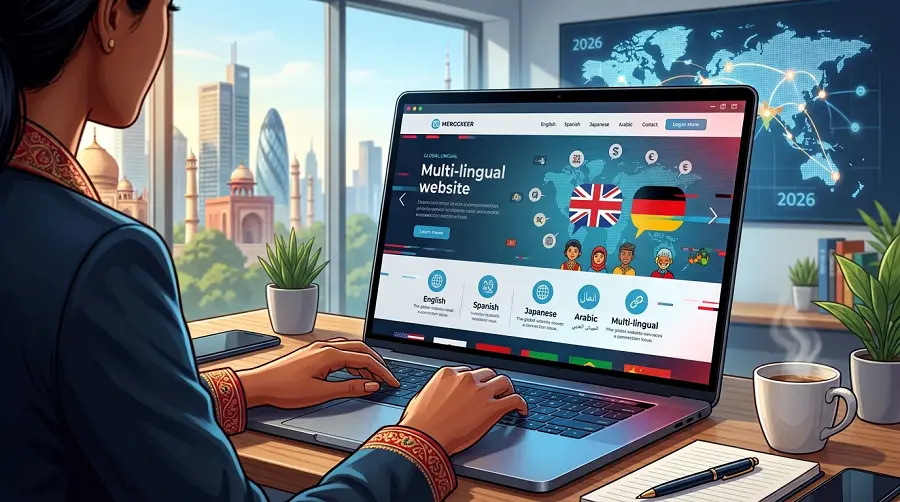
Multilingual website design is the process of building a site that presents your business, products and message in more than one language. Each version is structured so both visitors and search engines can find it easily.
It is not the same as dropping a free translation widget into the footer. Good multilingual web design accounts for layout, fonts, currency, cultural cues and technical SEO. Adapting content for a specific market is called language localisation. It works alongside internationalization, the groundwork that makes a site ready for many languages in the first place.
Why Indian Businesses Need a Multi Language Website in 2026
The Numbers Behind the Shift
A few figures show the size of the gap:
- CSA Research’s “Can’t Read, Won’t Buy” study surveyed 8,709 consumers in 29 countries. It found that 76% prefer buying products with information in their own language, and 40% will never buy from websites in other languages.
- A KPMG and Google report found that Indian-language internet users (234 million) had already overtaken English users (175 million) back in 2016.
In other words, English alone reaches only part of the market, whether that market is abroad or at home.
The Domestic Opportunity Many Brands Miss
India has 22 scheduled languages. A Kolkata sweet shop shipping across the country or a Pune edtech startup could gain as much from Bengali, Hindi or Marathi pages as from French or Spanish ones. A multi language website isn’t only for exporters. Regional buyers tend to trust a brand more when it speaks to them in the language they think in.
Core Elements of Strong Multilingual Web Design
A Clean URL Structure
Search engines need to see each language version as its own page. You have three common options:
- Subdirectories (example.com/fr/) keep all authority on one domain and are the easiest to manage.
- Subdomains (fr.example.com) offer more separation but split some SEO strength.
- Country domains (example.fr) send the strongest local signal, though they cost more to run.
For most Indian SMEs entering a handful of markets, subdirectories are the sensible starting point.
A Language Switcher People Can Find
Put it in the header and label each option in its own language, so “Deutsch” rather than “German.” Skip flags. A flag stands for a country, not a language, and Spanish alone is spoken in more than twenty countries.
Layouts That Flex
Translated text rarely stays the same length. German and Finnish often run noticeably longer than English, while Japanese can be much shorter. Arabic and Urdu use a right-to-left script, which flips navigation, icons and alignment. Solid multilingual website design plans for these shifts from day one so nothing breaks later.
Fonts and Scripts
Devanagari, Bengali and Tamil need fonts with proper Unicode support. A font that looks lovely in English can turn Hindi into broken boxes. Test every script on real phones, not just a desktop browser.
Local Details That Build Trust
Show prices in local currency, use familiar date and phone formats, and offer payment methods people actually use. A checkout that only accepts UPI won’t help a customer in Toronto. Even photographs should feel familiar to the audience you’re addressing.
SEO Essentials for a Multi Language Website
Translating a site without optimising it is like printing brochures and leaving them in a cupboard. Here is what matters most:
- Add hreflang tags so Google shows the right version to each user.
- Research keywords separately for every language, because people rarely search with literal translations.
- Translate meta titles, descriptions, image alt text and URLs.
- Let visitors choose their language instead of forcing redirects based on IP address.
- Submit a sitemap listing every language version.
These details are easy to get wrong, so many brands bring in an experienced SEO company in Kolkata before launch rather than after traffic disappoints.
Choosing the Right Multilingual Website Design Solutions
No single setup suits every business. Match the tool to your platform, catalogue size and budget.
- WordPress sites can use plugins such as WPML, Polylang or TranslatePress, which cover most small and mid-size needs.
- Shopify stores can use Shopify Markets to run multiple languages and currencies from one store.
- Custom or headless builds make more sense for large catalogues or brands planning to add many markets.
AI translation has improved a lot by 2026, but it still stumbles on tone, idioms and legal wording. A practical approach is to let AI produce the first draft and have a native speaker review it, especially for product pages, policies and support content.
The best multilingual website design solutions are the ones your team can actually maintain. A reliable website design company in Kolkata can plan the structure so new languages slot in later without a rebuild.
A Practical Roadmap to Get Started
Founders often ask us, “How do I make my website international without starting from scratch?” This order of work keeps things manageable:
- Check your analytics to see which countries and languages already visit.
- Choose two or three priority languages rather than ten.
- Audit the current site for hard-coded text, text inside images and fixed-width layouts.
- Settle on a URL structure and a platform or plugin.
- Translate and localise your highest-value pages first.
- Set up hreflang, sitemaps and local keyword targets.
- Test everything with native speakers on mobile.
- Launch, measure, then expand.
If “make my website international” has been on your to-do list for a while, a phased plan like this keeps costs predictable and results measurable.
Mistakes That Quietly Cost Global Sales
Some errors show up again and again:
- The homepage is translated, but checkout and support stay in English.
- Flags are used as language selectors.
- Auto-generated URLs end up full of odd characters.
- Translations fall out of date when the English page changes.
- Local search engines such as Baidu or Yandex are ignored in markets where they dominate.
Multilingual website design is one of the most direct ways an Indian business can earn trust abroad and in regional markets at home. Start small, localise properly and treat each language version as a real market rather than a copy. Once the pages are live, promotion matters just as much. Pairing them with search, social and paid campaigns from a digital marketing company in Kolkata that understands cross-border audiences turns a translated site into a working sales channel.
Frequently Asked Questions
How much does multilingual website design cost in India?
It depends on the number of languages, pages, platform and whether translation is human or AI-assisted. A small WordPress site with two or three languages costs far less than a large e-commerce store with dozens of product categories, so ask for a scoped quote.
Is Google Translate enough for a multi language website?
Not for pages that sell. Machine translation is a useful first draft, but a native reviewer should check tone, product terms and legal content.
Does multilingual web design help SEO?
Yes. Each language version can rank for local searches, provided it has hreflang tags, translated metadata and keywords researched in that language.
Which languages should an Indian business add first?
Look at your analytics and sales enquiries. Exporters often start with Arabic, Spanish, French or German, while domestic brands may see better returns from Hindi, Bengali or Tamil.
Should I use subdirectories or subdomains?
For most small and mid-size businesses, subdirectories are simpler and keep SEO authority on one domain.
Can AI tools handle website translation in 2026?
They handle bulk drafts well and save time, but human review is still important for accuracy and cultural fit.
 The Real Role of Website Design in SEO Ranking (What Most Businesses Ignore)
Learn how website design impacts SEO ranking. Discover how speed, UX, structure, and mobile design influence Google rankings...
Read article →
The Real Role of Website Design in SEO Ranking (What Most Businesses Ignore)
Learn how website design impacts SEO ranking. Discover how speed, UX, structure, and mobile design influence Google rankings...
Read article →
 5 Website Design Mistakes Kolkata Business Owners Still Make in 2025
Is your website silently losing leads? Discover 5 common website design mistakes Kolkata business owners still make —...
Read article →
5 Website Design Mistakes Kolkata Business Owners Still Make in 2025
Is your website silently losing leads? Discover 5 common website design mistakes Kolkata business owners still make —...
Read article →
 Freelancer vs Agency for Website Design in Kolkata – What’s Safer?
Comparing freelancer vs agency for website design in Kolkata. Learn the pros and cons, costs, and which option...
Read article →
Freelancer vs Agency for Website Design in Kolkata – What’s Safer?
Comparing freelancer vs agency for website design in Kolkata. Learn the pros and cons, costs, and which option...
Read article →