


Key Takeaway
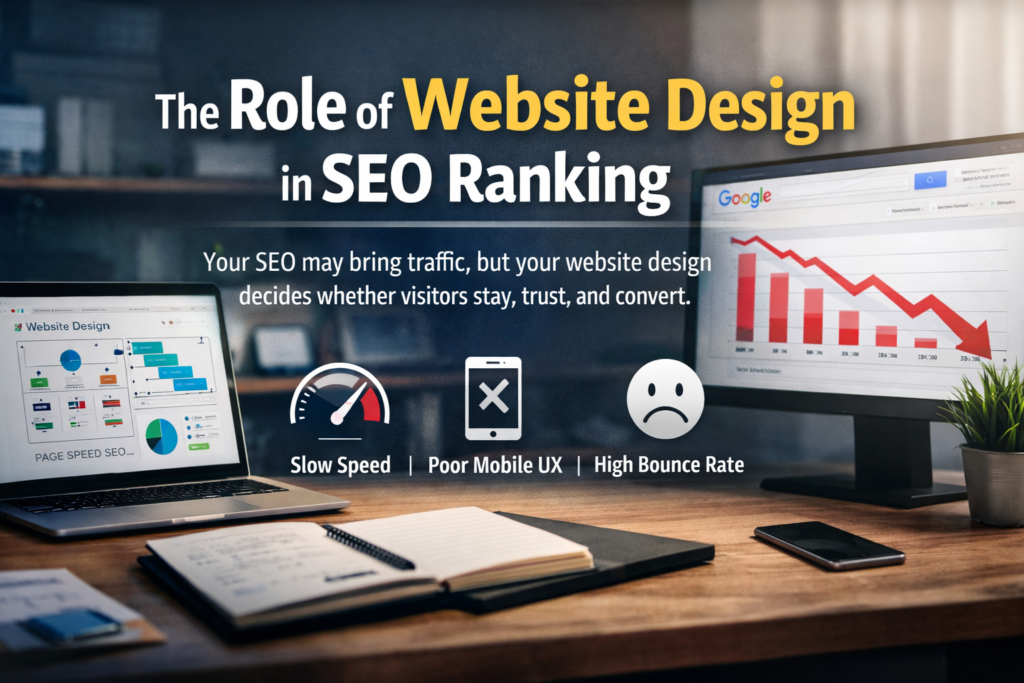
Website design directly affects SEO through page speed, mobile usability, site structure, navigation and user engagement. A beautiful site that loads slowly or confuses visitors will struggle to rank, so plan design and SEO together from the start.
Most people think SEO is all about keywords, backlinks, and content.
That’s partly true.
But here’s what many businesses don’t realize —
your website design can quietly make or break your SEO performance.
You might be investing in SEO, writing blogs, building links…
Yet your rankings don’t improve, or worse — you get traffic but no leads.
In many cases, the problem is not SEO.
👉 It’s the website design working against your SEO efforts.
Let’s break this down in a practical way.
Does Website Design Really Impact SEO?
Yes — and not in a small way.
Google doesn’t just rank content anymore.
It evaluates how users interact with your website.
That includes:
- How fast your site loads
- Whether it works smoothly on mobile
- How easy it is to navigate
- Whether users stay or leave quickly
If your website struggles in these areas,
👉 Google assumes your site is not helpful — and your ranking drops.
Why Many SEO Campaigns Fail Because of Poor Design
Let’s be honest.
You can:
- Target the right keywords
- Create good content
- Even get backlinks
But if users land on your site and feel confused, slow loading, or lack of trust —
👉 they leave.
And when users leave quickly, Google notices.
This is why many businesses say:
“We are getting traffic, but no leads.”
That’s not just an SEO issue.
👉 That’s a design + experience problem.
8 Practical Ways Website Design Affects SEO Ranking
1. Page Speed — The First Impression Happens in Seconds
No one likes waiting.
If your website takes more than 3 seconds to load, most users will leave before even seeing your content.
And when that happens:
- Bounce rate increases
- Engagement drops
- Rankings decline
Google has clearly made speed a ranking factor.
👉 A slow website silently kills your SEO.
2. Mobile Experience — Not Optional Anymore
Today, most searches happen on mobile.
If your website:
- Looks broken on mobile
- Has tiny text
- Needs zooming
Users will leave instantly.
Google uses mobile-first indexing, which means
👉 your mobile version is what Google evaluates first.
3. Navigation — Can Users Find What They Need?
Imagine a visitor lands on your site and cannot understand:
- Where to click
- What you offer
- How to contact you
They won’t spend time figuring it out.
They will leave.
A clear structure like:
- Home → Services → About → Contact
helps both users and search engines.
4. User Experience (UX) — The Hidden Ranking Factor
Good design is not just about looks.
It’s about how smoothly a user moves through your website.
If your website:
- Feels cluttered
- Has too many distractions
- Is hard to read
Users disengage.
👉 Better experience = more time on site = stronger SEO signals
5. Visual Trust — People Judge in Seconds
Before reading anything, users judge your website visually.
If your site looks:
- Outdated
- Cheap
- Unprofessional
They assume your service is the same.
Even if your SEO is perfect,
👉 trust issues will stop conversions.
6. Content Readability — Design Supports Content
Even great content can fail if it’s poorly presented.
Things like:
- Proper spacing
- Clear headings
- Easy-to-read fonts
make a huge difference.
Users don’t read — they scan.
Your design should help them scan easily.
7. Internal Linking & Structure — Helping Google Understand Your Site
A good design supports:
- Clean URL structure
- Logical page hierarchy
- Internal linking
This helps Google:
- Crawl your website
- Understand your content
- Rank pages better
8. Conversion Design — Turning Visitors into Leads
This is where most websites fail.
Even if you get traffic,
👉 without proper design, you won’t get leads.
A good website includes:
- Clear CTA (Call Now / Get Quote)
- Contact forms
- WhatsApp buttons
- Visible phone number
SEO brings traffic.
Design converts it.
Signs Your Website Design Is Hurting Your SEO
You might already have this problem if:
- Your website gets traffic but no enquiries
- Bounce rate is high
- Users don’t stay long
- Mobile experience is poor
- No clear call-to-action
If you relate to these,
👉 your design is likely affecting your SEO performance.
How to Fix Your Website for Better SEO Results
Now let’s talk about practical improvements.
Improve Speed First
Use:
- Lightweight themes
- Optimized images
- Fast hosting
Speed improvement alone can boost both ranking and conversions.
Make Your Website Mobile-Friendly
Test your website on mobile.
Check:
- Text readability
- Button size
- Layout
Fix anything that feels difficult to use.
Simplify Your Design
Don’t try to impress with too many elements.
Focus on:
- Clean layout
- Clear sections
- Simple navigation
Add Strong Call-to-Actions
Guide your visitors.
Tell them what to do next:
- Call now
- Get free audit
- Request a quote
Build Trust Through Design
Add:
- Client testimonials
- Real images
- Case studies
Trust is a major factor in conversion.
A Real Insight Most Agencies Won’t Tell You
Many agencies focus only on ranking.
But ranking alone doesn’t grow your business.
👉 What matters is:
Ranking + Experience + Conversion
If your website design is weak,
your SEO efforts will always feel incomplete.
Why SEO and Website Design Must Work Together
Think of it this way:
- SEO brings people to your website
- Design decides whether they stay or leave
Both must work together.
Otherwise, you are only doing half the job.
 My Website Is Not Ranking in Kolkata – What Should I Do?
Website not ranking in Kolkata? Discover why it happens and how local SEO, smart website design, and digital...
Read article →
My Website Is Not Ranking in Kolkata – What Should I Do?
Website not ranking in Kolkata? Discover why it happens and how local SEO, smart website design, and digital...
Read article →
 Why Your Website Must Load in Under 3 Seconds – A Complete Guide for Every Business Owner
Visitors leave slow websites within seconds. Learn why your site should load in under 3 seconds, what makes...
Read article →
Why Your Website Must Load in Under 3 Seconds – A Complete Guide for Every Business Owner
Visitors leave slow websites within seconds. Learn why your site should load in under 3 seconds, what makes...
Read article →
 Multilingual Website Design in 2026, A Complete Guide for Indian Businesses Going Global
Multilingual website design helps Indian businesses reach global and regional customers through localised content, flexible layouts, clear language...
Read article →
Multilingual Website Design in 2026, A Complete Guide for Indian Businesses Going Global
Multilingual website design helps Indian businesses reach global and regional customers through localised content, flexible layouts, clear language...
Read article →